 Ask anything
Search
how much notice do I need to give for annual leave
AI Overview
Annual leave needs two weeks of notice for anything up to five days, and a month for longer than that. Requests go through the leave form and are approved by your line manager. Carry-over is capped at five days and must be used by 31 March.
Knowledge Base Policy Manager
Show more
Showing top 101 results
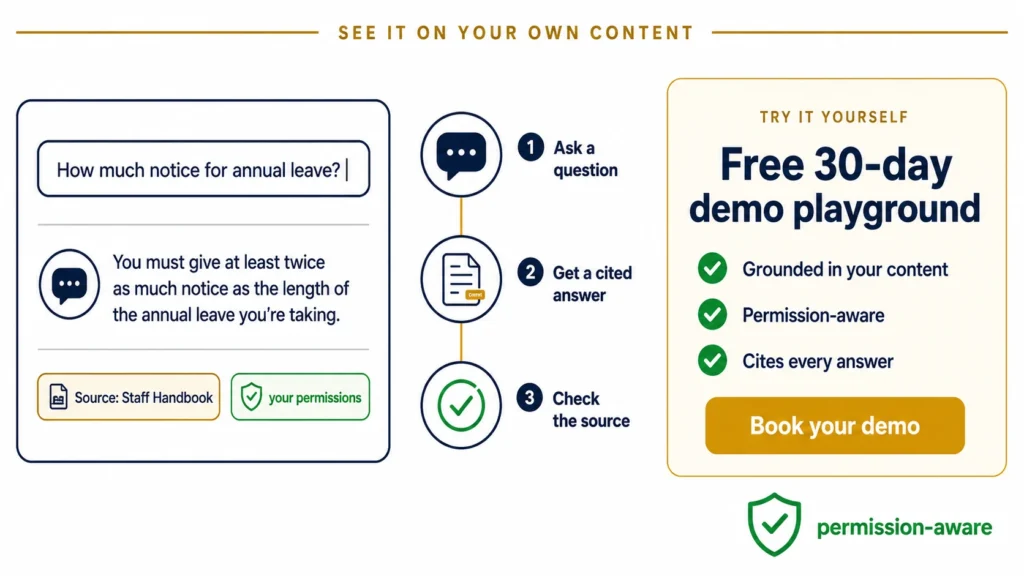
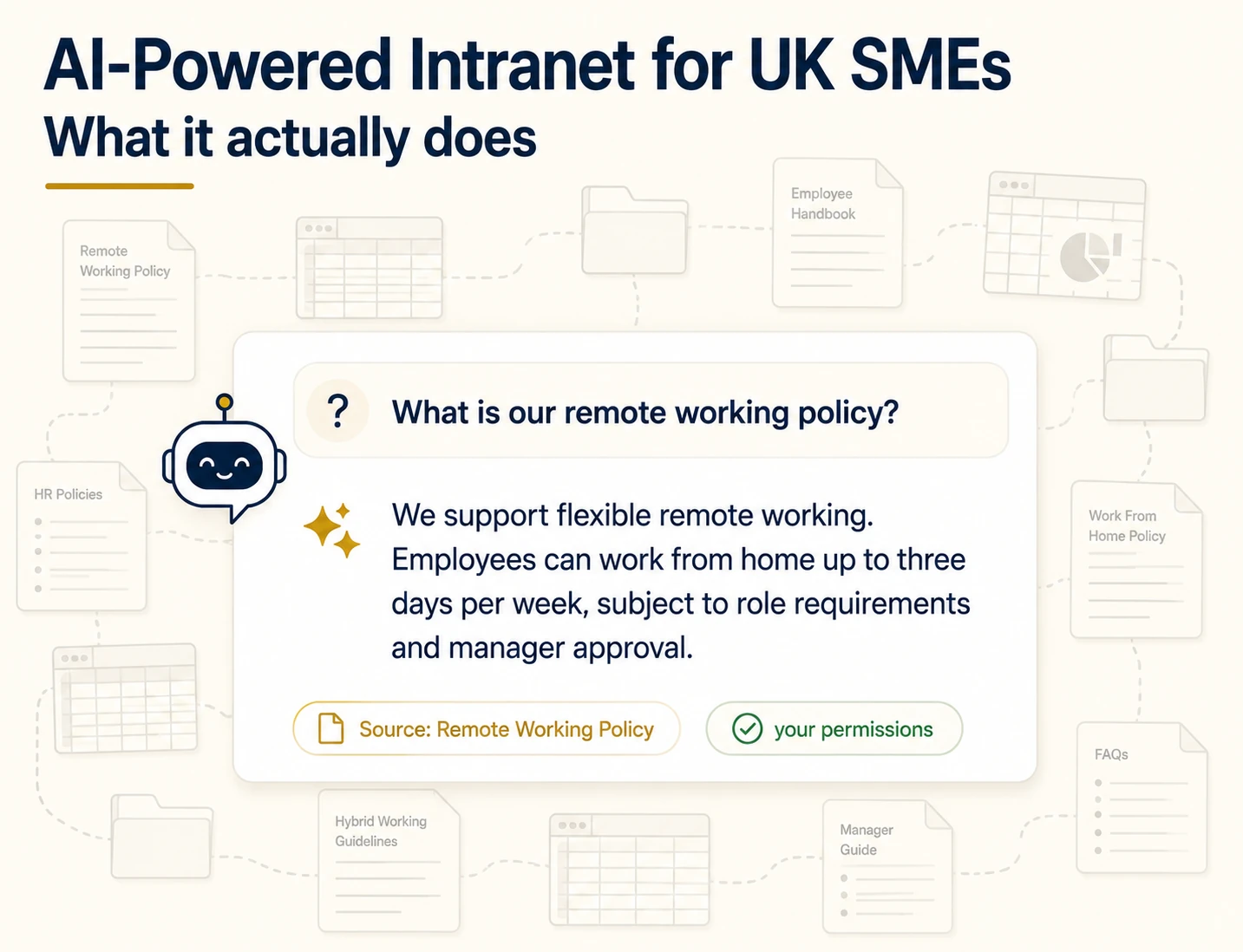
A working model of the real Claromentis AI Overview inside search, checked against the product. The company, question, answer and results are UK SME sample data. It answers from your own content and cites it, which means fewer wrong answers that you can check, not none.
Ask it your own questions, free for 30 days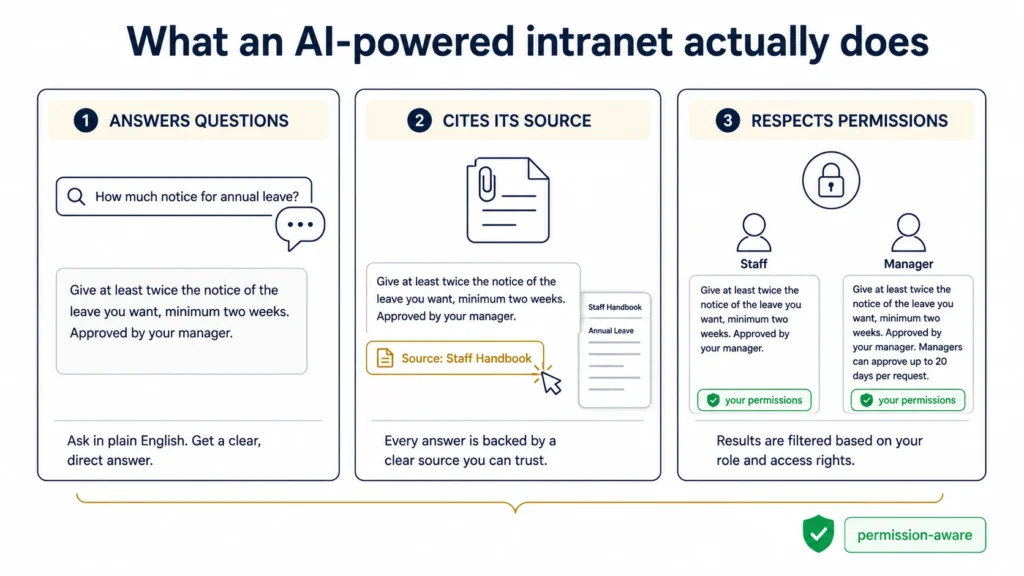
Does it really stop the AI making things up?
It reduces them, but it does not remove them. This is the honest bit the brochures skip.
Grounding is the mechanism doing the work. The system retrieves your relevant documents first. It then asks the model to answer using only those, and cites the source (Microsoft, 2026). That cuts invented answers and lets staff check them. It cannot rescue a document that is wrong or out of date.
Grounding an answer in your own documents, and showing the source, does cut down on invented answers and lets people verify what they read. That is a real improvement on a chatbot guessing from the open web. But grounded AI can still misread a document, blend two of them, or answer confidently from an outdated one. Treat it as “fewer wrong answers, and you can check them”, never as “no wrong answers”.
The practical consequence: an AI-powered intranet is only as trustworthy as the content beneath it. Practitioners have a phrase for what goes wrong, which is that answers rot as the intranet fills with conflicting drafts and nobody owns the official version. So the fix for hallucination is not a cleverer model. It is tidier, owned content.
What is the real risk of AI on your intranet?
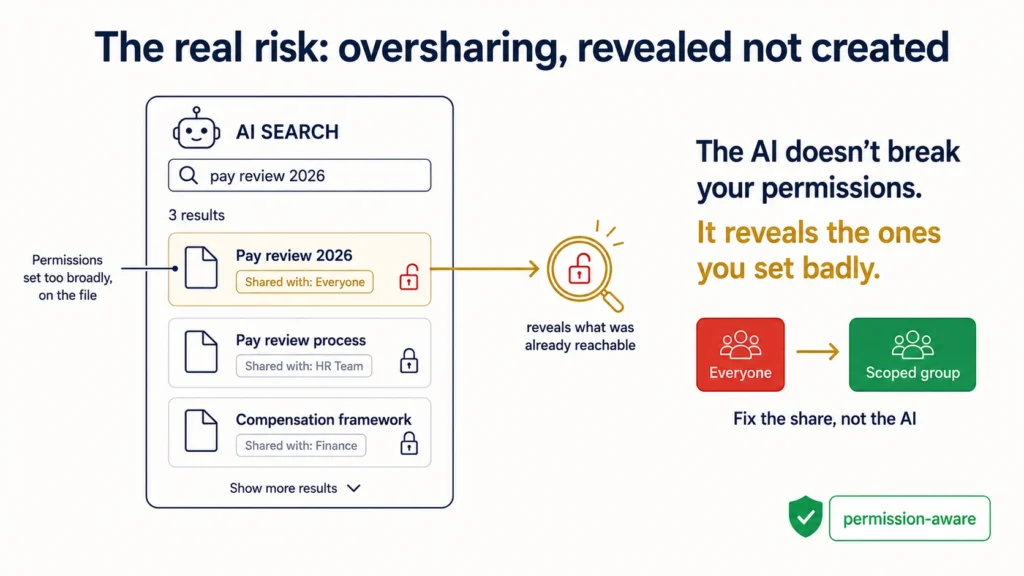
Not invention. Exposure. The bigger risk is the AI faithfully surfacing something a member of staff could already technically open, but was never meant to rely on or even notice.
Microsoft puts this plainly about its own tools: the AI generates only from what the user can already access. A gap in governance, an over-shared site or a stray “everyone” link, gets amplified and made easy to find (Microsoft, 2026). The AI does not break your permissions. It reveals the ones you set badly.
It can be weaponised, too. In June 2026 researchers disclosed SearchLeak, a one-click flaw in Microsoft 365 Copilot search that could have leaked indexed data (Varonis, 2026). Microsoft rated it critical and patched it. It was caught and fixed, not exploited in the wild, but the lesson stands: AI bolted onto search needs securing, not just switching on.
Does your SME actually need an AI-powered intranet yet?
Here is the honest test. AI search earns its keep in three cases. When staff genuinely lose time hunting for information. When you carry a real compliance load. Or when you are growing past the point where everyone just knows where things live. If none of that is true, a plain, well-organised intranet is still fine.
| Your situation | A plain intranet is enough | An AI-powered intranet earns its keep |
|---|---|---|
| Findability | Small, tidy content; staff know where to look | Staff lose real time hunting across scattered docs |
| Compliance | A few policies, light audit | Many policies, constant “which version is current” |
| Headcount | Under ~20, one team | Growing past 30 to 50, several teams or sites |
| Content quality | Owned and current | Messy and conflicting (fix this before any AI) |
Sitting in the right-hand column? The case is strong. On the left, spend the money on getting your content in order first. That alone makes the next step cheaper, and our seven-platform comparison shows which ones include native AI search when you are ready.
What about the “hours wasted searching” statistics?
Be sceptical, because most of them do not hold up. The famous “2.5 hours a day searching” line is a misquoted general estimate from a 2001 IDC paper, not a measured fact (Intranet Focus, 2020). It has been repeated for two decades as though it were gospel.
The more defensible number is older and lower. McKinsey found knowledge workers spend around 19% of the week, nearly a day, on internal search (McKinsey, 2012). A recent UK survey by Atlassian puts it at nine hours a week (Atlassian, 2025). Atlassian sells search software, so treat that as a vendor figure, not independent proof.
The takeaway is not a precise number. It is that searching is a real, recurring tax on a growing team, and worth measuring in your own business before you buy a tool to fix it.
How do you get an AI-powered intranet right?
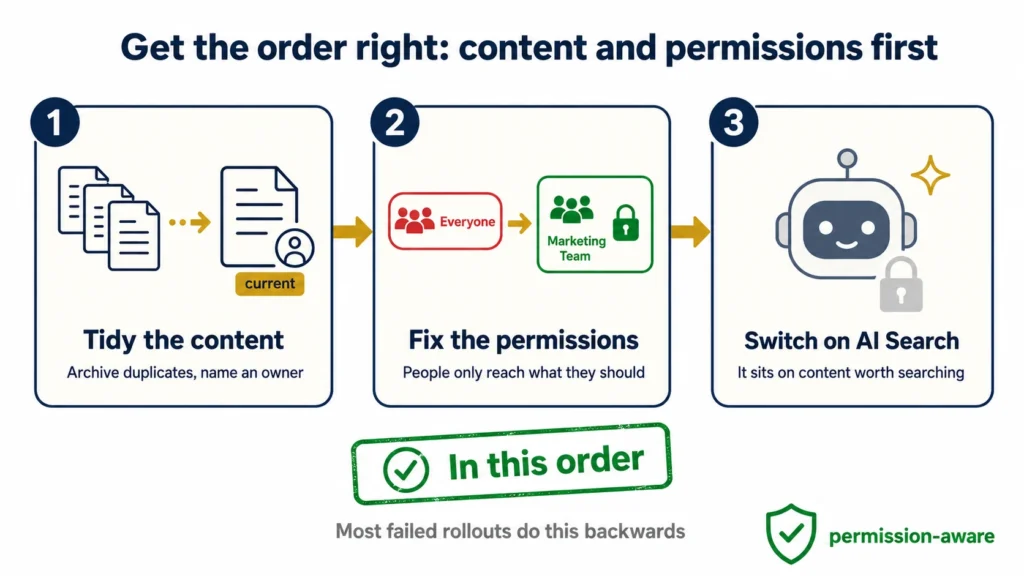
Content and permissions first, AI second. The order matters, and most failed rollouts get it backwards.
Microsoft’s own guidance is blunt about the order. AI amplifies whatever governance gaps already exist. An over-shared site or a stray permission becomes easier to find, not safer (Microsoft, 2026). That is why the sequence runs content, then permissions, then AI.
- Tidy the source content. Archive the duplicates, name an owner for each key document, and make the current version the obvious one.
- Fix the permissions. An AI intranet enforces your existing access rules as it retrieves a document, not after. That stops it surfacing what it should not.
- Then switch on the AI. Pair the rollout with a clear AI usage policy. Staff then know what they can ask, and what must never go into any AI tool.
This is also the argument for keeping everything together. Put search, documents, the staff directory and your policies on one connected platform. Then the AI has one clean, permissioned place to read from, with one audit trail. Scattered tools, each holding a slice of the knowledge, are exactly what makes AI answers unreliable.
The bottom line for UK SMEs
An AI-powered intranet for UK SMEs is a genuinely useful thing, sold with more certainty than it deserves. It answers staff questions from your own content and cites the source, which beats a folder hunt. And it reduces wrong answers without removing them, while exposing the permissions you set badly rather than fixing them for you.
So the honest sequence is the same one that has always worked: get your content and permissions in order, then let AI sit on top of something worth searching. Do that, and an AI-powered intranet repays the effort. Skip it, and you have just made the mess easier to find.